2013
Eric Rosenthal
Founder + Executive Director
Disability Rights International
About
Jewish Values
“The Jewish principle from the Torah – ‘Do not oppress the stranger, because you were strangers in the land of Egypt’ – is very powerful to me. As a people, we care deeply about family and community; and as a people we have a particular responsibility to help ensure that people with disabilities grow up with families; are part of communities; and are not marginalized, dehumanized and put away.”
Global Impact
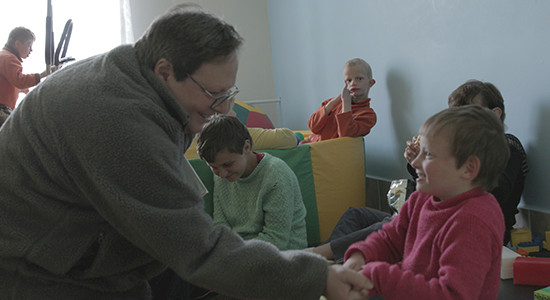
The mission of Disability Rights International (DRI) is to awaken the world’s conscience to the urgent need to protect the human rights of people with disabilities and ensure their full participation in society. Through human rights litigation, investigative reporting and media campaigns in dozens of countries, DRI has brought unprecedented world attention to the concerns of children and adults segregated from society in institutions — where they are often subject to atrocious abuses.
Rosenthal helped draft the UN Convention on the Rights of Persons with Disabilities (CRPD) and DRI media campaigns helped build global support for its ratification. As Vice President of the US International Council on Disabilities (USICD), Rosenthal co-led the effort to bring about US ratification of the Convention. DRI has also worked with the US Congress to draft the International Children with Disabilities Protection Act, which was introduced in Congress with bi-partisan support.
On behalf of DRI, Rosenthal has brought ground breaking cases to international human rights bodies establishing enforceable rights for people with disabilities. In a case against the Untied States, Rosenthal gained recognition that the use of electric shock as punishment for children with disabilities may constitute torture in violation of international human rights law. DRI has brought and won cases against Guatemala, Mexico, Paraguay, and Serbia establishing a right for children and adults with disabilities to live in the community. DRI cases have closed down abusive institutions and earned financial reparations for thousands of people with disabilities. One case pending against Guatemala will establish protections for children who have been trafficked from an orphanage and will create accountability for 41 girls killed in a fire at the facility after protesting their own forced prostitution (See Eric Rosenthal, The Guatemala Fire Tragedy shows why its finally time to get rid of orphanages, The Washington Post, 2017).
DRI launched a Worldwide Campaign to End the Institutionalization of Children to convince governments and donors to support community and family inclusion of children. DRI is now leading the effort worldwide to promote recognition and enforcement of the right of all children to live and grow up with a family. Drawing on the volunteer assistance of people with disabilities, attorneys, judges, and professionals from the United States, DRI has trained activists in 40 countries and spun off disability-run advocacy organizations in six countries.
During the Covid-19 pandemic, DRI turned its attention to protecting people with disabilities who are threatened by exposure to the virus in congregate care facilities. DRI created a Global Coalition on Deinstitutionalization and drafted international standards to protect people with disabilities during emergencies.
After Russia’s full-scale invasion of Ukraine, DRI was the first organization to bring international attention to the impact of the war on children with disabilities and to the plight of children left behind and overlooked by international assistance. DRI’s work was covered extensively by the international press, including 11 stories on BBC and a profile by Richard Engel on NBC News. Through its affiliate in Ukraine, DRI continues to organize families of children with disabilities to keep their sons and daughters safely in the community despite the hardships of war (see Families Find A Way).
DRI is now organizing an alliance of US disability rights to seek restoration of US government funding for international disability rights and the preservation of disability rights at home and abroad.
Biography
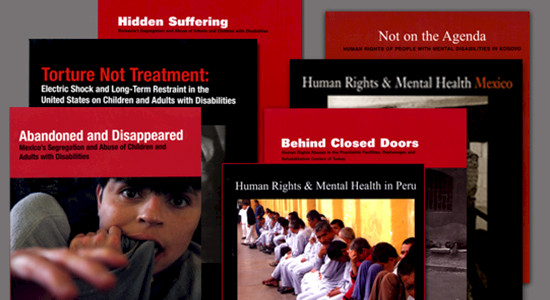
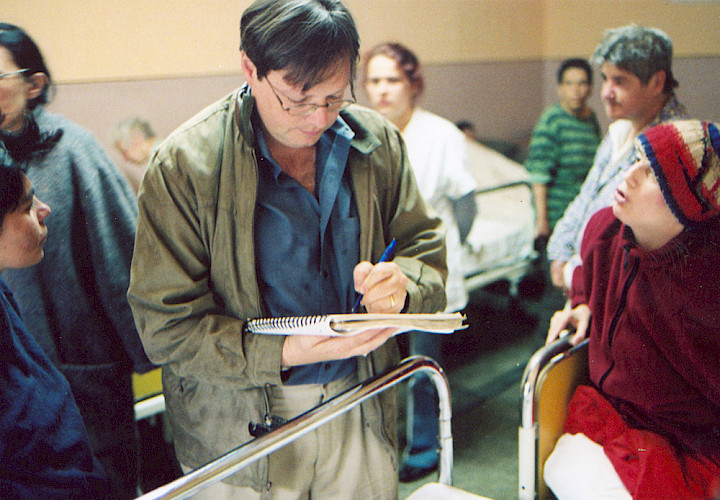
Eric Rosenthal is Founder and Executive Director of Disability Rights International, a Washington, D.C. based non-profit working globally to end the segregation and abuse of children and adults with disabilities. An attorney, law professor, and a humanitarian, Rosenthal founded DRI in 1993 to bring world attention to often brutal conditions and inhumane treatment of people with disabilities in custodial facilities. Rosenthal has trained activists and conducted human rights investigations in more than 36 countries and authored human rights reports on conditions of people with disabilities in 16 countries.
DRI has brought path-breaking cases before the Inter-American Commission on Human Rights, including the first successful petitions for urgent “precautionary measures ” — to protect the lives of children and adults in the orphanages and psychiatric facilities of Paraguay and Guatemala. DRI cases from Guatemala and Mexico are the first of their kind to protect the right to community integration for people with disabilities under international law. DRI’s Casa Esperanza case in Mexico seeks an end to exploitation, trafficking, and forced sterilization of women with intellectual disabilities.
Rosenthal has served as a consultant to the US National Council on Disabilities (NCD), the World Health Organization (WHO), the United Nations International Children’s Emergency Fund (UNICEF), the UN Special Rapporteur Against Torture. He has served as an advisor and mentor in the Public Interest Law Scholar’s program of the Georgetown University Law Center where he has been an adjunct professor of law in public interest advocacy. He received an honorary doctor of laws from Georgetown and was appointed to the Father Robert Drinan Chair in International Human Rights Law.
Rosenthal now teaches international human rights practitioners through the Academy for Human Rights and Humanitarian Law at American University’s Washington College of Law.
As the son of a career diplomat, Rosenthal was raised in Washington, D.C., Tunisia, Cote d’Ivoire, and Niger. Rosenthal lived in Israel and volunteered at Kibbutz Revivim. He also volunteered at Neve Shalom/Wahat as Salam, where he promoted Arab-Jewish understanding and herded sheep.
Rosenthal earned a B.A. in Politics, Economics, Rhetoric and Law (PERL) in 1985 and a law degree from Georgetown University in 1992.
His interest in the rights of the disabled was influenced by his grandmother, an émigré from Eastern Europe, who was diagnosed with manic depression. This personal connection, combined with work in the human rights and legal communities around the world, led him to recognize the void in basic protections for people with disabilities.
The tipping point for Rosenthal came in 1992 when, just out of law school, he traveled to Mexico on behalf of Minnesota Advocates for Human Rights to document abuses against the indigenous population in Chiapas. While there, he visited the main psychiatric hospital in Mexico City, where he was so appalled by the physical and treatment conditions that he committed himself to advocating for the human rights of people with disabilities around the world and to create global change.
Rosenthal and his work have been profiled by The New York Times Magazine (The Global Willowbrook), 20/20, Good Morning America, and Nightline, and have been the subject of editorials in The New York Times, The International Herald Tribune, and The Washington Post.
In addition to being the 2013 recipient of the Charles Bronfman Prize, Rosenthal has earned an Echoing Green Public Service Fellowship, the Mental Health Association of New York City Humanitarian Award, the Thomas J. Dodd Prize in International Justice and Human Rights (accepted on behalf of DRI), an Ashoka Fellowship, the Henry B. Betts Award from the American Association of People with Disabilities for “pioneering the field of international human rights advocacy for people with disabilities,” the American Psychiatric Association’s Human Rights Award, and the University of Chicago Public Service Award. He was appointed to serve as the 2015-2016 Robert Drinan, S.J., Chair in International Human Rights at the Georgetown University Law Center. He lives in Washington, D.C. and Plum Island, MA with his family.